
How to Plant a Tree or Shrub
Trees shade and cool our streets, provide habitat for our wildlife, add beauty to our neighborhoods and yards, and remove tons of carbon dioxide from the atmosphere. The simple act of planting a tree in your yard, neighborhood, school, or watershed will do wonders for the health of our planet and ourselves.
Proper planting is critical to their survival and long-term success.
Digging the Hole
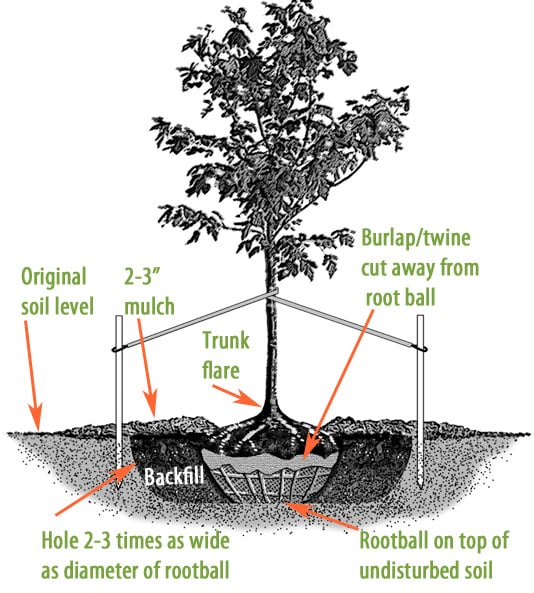
Planting too deep is the top reason that trees and shrubs die. Follow these simple steps to ensure the correct planting depth for both balled-and-burlapped (B&B) and potted trees.
- Locate the point at which the trunk flares out to join the roots. On B&B trees, remove the twine and burlap at the base of the trunk. If necessary, gently push the soil away from the base of the trunk to find the flare.
- Measure the distance from the bottom of the root mass to the trunk flare. Dig the hole no deeper than this; you want the root mass to sit on undisturbed soil. When planting is complete, the trunk flare should be slightly above the existing soil grade.
- Dig the hole two to three times the diameter of the root ball or container, sloping the sides gently outward to the existing soil grade.
Planting
When moving your plant into the planting hole, disturb the rootball as little as possible. Lift B&B trees and shrubs by using the rope, burlap or wire cage on the rootball. Lift potted plants by grasping the container. Don't lift plants by the trunk, stems or branches. Don't allow the root system to dry out before or during planting.
The thinking on backfill has changed in recent years. Although it was once common to modify the backfill soil with amendments — such as compost, peat moss, aged manure and other ingredients — it is now considered best practice to leave the backfill unaltered or add minimal amendments. This encourages roots to spread out into the native soil, rather than staying within the confines of the planting hole.
We do recommend adding mycorrhizal fungi to the backfill. Mycorrhizal fungi form associations with plant roots and help them extract and absorb minerals and water from the soil. Trees and shrubs with mycorrhizal-enhanced root systems adapt better and are more tolerant of stressful environments. Bone meal provides essential minerals that promote sturdy root systems and stimulate plant growth.
B&B trees and shrubs
- Place the tree in the center of the hole. If necessary, straighten or stabilize the tree by adjusting or filling beneath the root ball with the backfill mix.
- Cut away any twine or burlap from the base of the trunk and remove any burlap that is on the top of the rootball. Remove excess soil from the top of the rootball to expose the trunk flare, if needed.
- Use bolt cutters to remove as much of the wire basket as possible. Don't try to remove the entire wire basket. The plant will thrive even if there is some of the basket left in the hole. Remove all the rope and twine from the rootball, as well as any nails holding the burlap together. Pull back the burlap and cut away any loose material. It's OK to leave some burlap in the hole to decompose. However, remove all plastic or treated burlap.
Potted trees and shrubs
- Tip the container on its side and slide the plant from the container. Place the plant in the hole by lifting the root mass, not the plant itself. If the plant has become pot-bound, it may be necessary to cut the container before the plant can be removed.
- To encourage root growth, tease the outer roots from the soil. If the roots are tightly matted, use a knife to score the root mass in several places and gently loosen the root ball. This won't harm the plant and will encourage new root growth.
Backfilling
- Add backfill soil to your planting hole until it comes about halfway up the root ball. Use your foot or hands to firm the soil and eliminate air pockets. Make sure the trunk is vertical and confirm that the trunk flare will sit slight above soil grade once backfilling is complete. Continue adding backfill and packing it down until you've reached the top of the root ball, taking care not to cover the trunk flare.
- Construct a 3" - 4" high ridge of soil around the outer edge of the planting hole. This berm will create a basin to hold irrigation water and concentrate it over the roots. Use a hose to fill the basin, then allow the water to soak it, repeating several times. Or, let the water run at a trickle for 15 to 30 minutes to ensure that the entire root zone is moist. The goal is to ensure even watering so the soil is drenched and any large air pockets are eliminated.
- Recheck that the trunk flare is completely exposed and the top of the root ball has not been covered with additional soil. Remove any plant tags or labels from the tree.
Mulching
Apply bark mulch or pine straw to a depth of 2" - 3" over the entire planting hole. Mulching helps conserve water and prevent weeds. Taper the mulch toward the base of the tree, but do not allow it to touch the tree trunk.
Staking
Staking at planting time is not always necessary. Consider the stability of the rootball, trunk size and strength, direction of prevailing winds, canopy size and density when determining whether or not to stake. If in doubt, ask a nursery professional.
Fertilizing
We do not recommend fertilizing newly planted trees and shrubs during their first year of growth.
Watering
Proper moisture is critical to the survival of your young tree or shrub. The roots should never dry out completely, nor should they be waterlogged. The best way to check soil moisture? Use your finger. Dig down 2" to 4" just outside the root mass of the plant and water if the soil feels dry. Newly planted shrubs and trees should be checked and watered every other day for the first two weeks. After the first two weeks, limit watering to once a week if less than 1" of rain falls during the week. Thorough soakings that moisten the soil to the entire depth of the root mass are better than frequent light waterings.
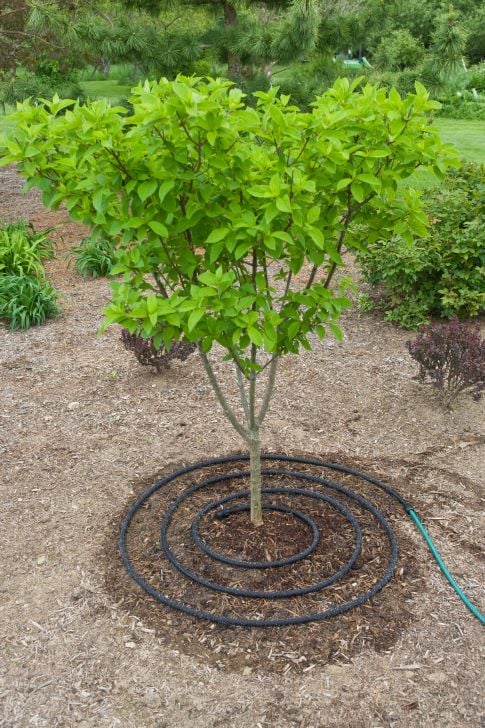 A newly-planted, tree-form hydrangea with Snip-n-Drip soaker hose for watering.
Use the chart below as a guideline for the amount of water needed by newly planted trees and shrubs based upon plant size. Plant species have varying water requirements. Before watering according to the chart, use your finger to check actual soil moisture and get familiar with the moisture requirements of your plants.
| Plant Size | Amount of Water per Application |
| Small shrub | 4-5 gal. |
| Large shrub | 7-10 gal. |
| Small trees (<2" caliper) | 7-10 gal. |
| Large trees (>2" caliper) | 1020 gallons |
Water measurements can be made using an old 1-gallon plastic milk container. When using a hose, turn on the water at a slow trickle and take note of the setting. Count the amount of time it takes to fill the 1-gallon container. Multiply that amount of time by the number of gallons you need for your plant. That total provides the amount of time you need to run the hose, based on the chart.
Print this Article:
Get the Dirt
Stay up to date on new articles and advice. Please fill out the information below.