
Planting Plans for Elevated Raised Beds
Delicious AND edible? Two designs to inspire you

Last updated: July 26, 2023 | 5 min read
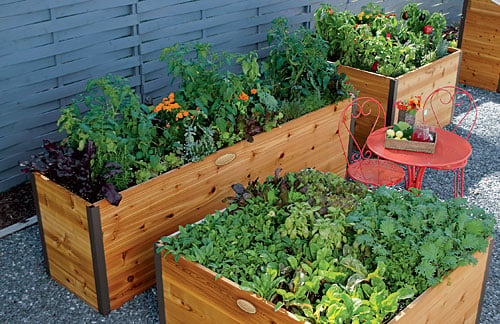 Our Vermont-made Elevated Cedar Raised Beds
We asked kitchen garden expert Ellen Ecker Ogden to create planting plans for a couple of our Elevated Raised Beds. We're pleased to show results, both beautiful and delicious.
A Paint Box Garden for Edible Plants
For the Elevated Cedar Raised Bed (2' x 8')
The Plants
(A) Marigold, Lemon Gem (8 plants): Tagetes tenuifolia is an unusual, single-petal marigold. Ferny mounds of lemon-scented foliage provide plenty of edible flowers all season. Sow seeds or start with transplants; space them 6?8" apart. Another option: Replace some of the marigolds with trailing nasturtiums.
(B) Alpine Strawberry (12 plants): Alpine strawberries are best planted in early spring, and require only six hours of intense sun in order to fruit. Some species of alpine strawberries send out runners; trim them to keep the plants vigorous. Harvest fruit frequently for continuous production all summer. Look for plants at good garden centers.
(C) Kale (2 plants): Kale is a staple of the garden — also one of the easiest and most satisfying greens to grow. The beautiful plants provide an abundance of healthy, showy greens over a long season. Look for plants at the garden center in cell-packs or 4" pots. My favorite varieties include Red Russian, Black Tuscan, Redbor and Winterbor.
(D) Cucumber (4 seeds or plant 4 plants) Cucumbers like to grow vertically on a trellis, where they take up less room than when they're allowed to sprawl on the ground. I used an A-frame trellis (see Trellis Options, below) and planted two plants on each side, at the base of the trellis. Favorites include: Lemon, Diva, or Suyo Long.
(E) Pole Beans (6 seeds or 6 plants) Plant pole beans on a trellis and you'll find that the succulent beans are easy to spot and harvest without bending. If you use an A-frame-style trellis, you can plant three plants on each side, at the base of the trellis. Favorites include: Trionfo Violetto (Italian purple pole bean), Kwintus, Fortex or Matilda.
Ellen's Notes on the Design
Mixing plants of varying heights will reward you with high productivity in a small space. Add colorful plants and you have a long-lasting paint box garden to bring visual as well as edible enjoyment.
Plant a row of tall pole beans, flanked by lemon cucumber, for a dramatic vertical element. Add Lemon Gem marigolds and kale as accents, alternating with low-growing alpine strawberries to frame the edges.
Remember that frequent harvesting encourages more growth, so keep up with the harvest to guarantee abundance.
In many designs, it's effective to combine heights, textures and colors. I also like to limit the choice of materials in each bed, to create a massing effect that gives the design unity. In this garden, the number of plants is kept to a minimum, yet each variety works with the others to create a gorgeous display of long-lasting edibles in a small space.
The tall pole beans and cucumbers add a vertical element, while the mid-level kale and marigolds add texture and fragrance. Alpine strawberries provide a framework along the edges of the garden. If you find you still have room, tuck in a few blue lobelia or chive plants.
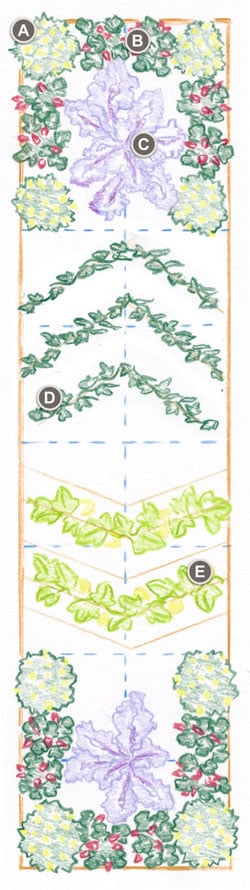
(A) Marigold (B) Alpine strawberry (C) Kale (D) Pole bean (E) Cucumber
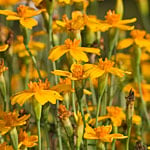
Tagetes tenuifolia, also known as signet marigolds, are available in orange and yellow.
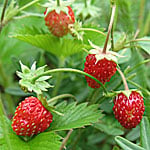
Alpine strawberries are much smaller than conventional strawberries.
Ornamental Edible Garden
For the Elevated Cedar Raised Bed (4'x4') or the 4' x 4' Elevated Cedar Planter Box
This garden provides plenty of options for the culinary gardener. With a strong focus on color and flavor, it makes the most of a small space and provides a variety of vegetables that will fill your salad bowl and add zip to your salsa.
The Plants
(A) Imperial Star Artichoke (1 plant): Look for Imperial Star, a newer variety that usually forms several artichokes per plant in the first year. Harvest as buds (artichokes), or allow them to develop into purple, thistlelike flowers. Even without a harvest, the finely-cut, gray foliage makes a handsome display.
(B) Rainbow chard (4 plants): One of the best ornamental plants for the kitchen garden, this long-season chard is equally useful as a decorative border plant. It's also a valuable source of mineral-rich greens for fresh eating. Direct-sow seeds or start them indoors. You can also find chard as transplants at some garden centers.
(C) Bianca Riccia chicory (4 plants): Relatively tolerant of heat and cold, this long-season green can be plucked leaf by leaf for the salad bowl, with remarkable cut-and-come-again productivity. The blonde leaves are nicely fringed with pinkish highlights. If you can't find Bianca Riccia, use any type of heading chicory. Other alternatives are cabbage or Asian greens, such as bok choi.
(D) Purple Ruffles basil (4 plants): The basil family comprises close to 80 different types, although only about a dozen are used for cooking. Purple Ruffles offers both texture and color. Use the leaves as a garnish or make herb vinegar. To keep it from getting leggy, keep snipping the top set of leaves to encourage plants to grow bushier.
(E) Serrano hot pepper (4 plants): Because of the wide variety of shapes sizes and colors, peppers are some of the most interesting crops to grow. They prefer warm weather and need a long season to mature. Hot peppers will be more prolific than sweet peppers.
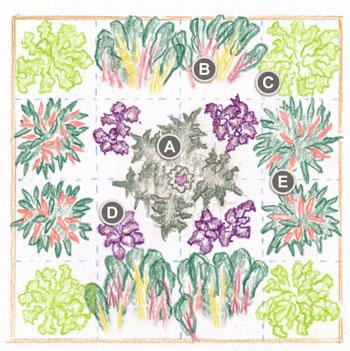
(A) Imperial Star artichoke (B) Rainbow chard (C) Bianca Riccia chicory (D) Purple Ruffles basil (E) Serrano Hot pepper
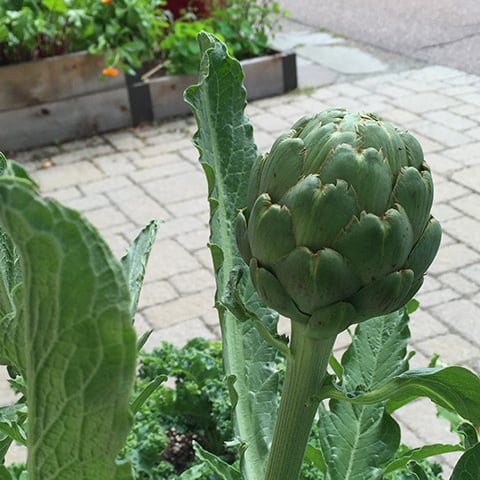
Artichoke
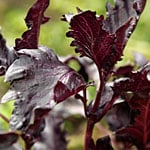
Purple Ruffles basil
Ellen's Notes on the Design
When I consider what to grow in my kitchen garden, it usually comes down to two things: what I can't buy in the market, and what will produce the best flavor. As a cook and a gardener, I look for a range of color, texture and culinary purpose. In this garden, you'll find some of my favorite varieties.
A single artichoke in the center adds height and visual interest, surrounded by the purple basil, which contrasts nicely with the silvery-gray artichoke leaves. Rainbow chard anchors the ends with an upright posture, flanked by chicory, a salad green that can handle the summer sun. For a bit of flair, hot peppers offer a wild element. Another option: replace the peppers with miniature eggplant.
This design introduces plants that have a relatively long season, to ensure good color and productivity. Accent this garden with trailing nasturtiums and dark sweet potato vine, tucked into the edges so the vines can spill over the sides.
Filling the Beds with Soil
The elevated beds are meant to be filled with what's unusually called "potting soil." A better description is "planting mix," a blend that ensures good moisture retention and drainage. Do not use regular garden soil. It won't drain freely when used in a planter. Use a blend that's formulated for pots and planters. You can also create your own planting mix by combining topsoil, compost and potting soil. Get the the "recipe" on our Soil Calculator page.
How Much?
Because they share the same square footage, both beds hold about 13 cubic feet (329 dry quarts) — that's about 17 20-quart bags of potting soil.
Watering?
Careful, consistent watering is key to a good harvest. Make sure your bed is located where you have access to water. For best results, install a soaker system, such as one of our Snip-n-Drip systems, which can be customized to fit any shape.
Print this Article:
Get the Dirt
Stay up to date on new articles and advice. Please fill out the information below.