
Choosing The Best Birdhouse
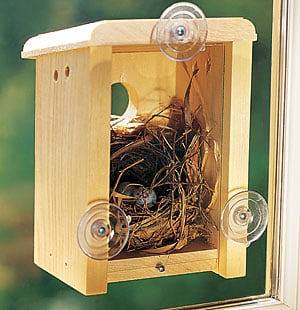 From gathering twigs, to laying eggs, and finally the chicks hatching, you can observe the whole nesting process right outside your window with this handcrafted Window Nest Box. It has suction cups that attach easily to any window, and a 1-1/2" opening that suits most song birds.
Most birds build their nests in a tree or shrub. But there are more than two dozen North American bird species that prefer to nest in a natural cavity, such as a hole in a dead tree. These cavity-nesting birds will often adapt to nesting in a birdhouse (also known as an artificial nesting box). Providing nesting boxes, especially in urban and suburban areas, is an important way to help these bird species survive, as natural nesting cavities become more and more difficult to find.
If you'd like to lend birds a hand by putting up some nesting boxes, it's important to recognize that most bird species have specific preferences for the kinds of cavities — or nesting boxes — that they'll use. For some, the orientation is important. Others are particular about the internal size of the house, or the size of the entrance hole. Here are some of the things to think about when adding a birdhouse to your yard:
Location
Though some bird species want their nesting box attached right to the trunk of a tree, in most cases bird houses should be mounted on a sturdy pole or post to help discourage predators such as rodents and cats. For additional protection from predators, the post can be wrapped with sheet metal or a length of stovepipe. Birdhouses that are hung in a tree should be placed at least 5 ft. high to avoid cat problems. It's best to locate bird houses in a relatively open area, since birds like to have a clear flight path to the entrance for delivering food. The entrance hole should face away from the prevailing wind to protect young birds from rain and cold winds. In warm climates, face the box north or east to help keep the interior cool. As a general rule, put no more than four nesting boxes in a 1-acre area.
Materials
In most cases, a natural wood nesting box is best because metal and plastics can build up excess heat. Avoid using wood that’s been treated with stain or a preservative. There should be drainage holes on the bottom of the box, and ventilation holes to ensure a flow of fresh air. Most birds seem to prefer weathered wood over new wood, so a new birdhouse may need to weather for a year before birds find it appealing. Birds start scouting for lodging in very early spring, so make sure the house is up and ready for viewing early in the season.
Box Size
Most common backyard bird species like a compact house: about 4-6" square at the base, and 6-12" deep. A box of this size will suit birds such as wrens, swallows, chickadees, titmice, nuthatches, downy woodpeckers and prothonotary warblers. Nesting boxes for flickers, owls, wood ducks and kestrels need to be larger at the base and both taller and deeper.
Hole Size and Position
For most species, the diameter of the entrance hole should be between 1-1/4" and 1-1/2". Making the hole as small as the species will tolerate discourages other species from taking up residence. Starlings pose a threat to eggs and nestlings when the entrance hole is larger than 1-1/2" in diameter. Swallows love nesting boxes and if you have a good population of swallows in your area, they will probably be the first to claim the box. These wonderful insect eaters can squeeze into even the smallest size entrance hole, so if you want to house other bird species as well, put up two identical bird houses within 20 ft. of each other. Swallows are territorial, and will inhabit only one of the houses, leaving the other to be occupied by bluebirds or other types of birds. The entrance hole on a nesting box should be located between 4" and 7" above the floor. This distance, like the entrance hole size, is particular to each species (see chart in link below).
Housekeeping
Every nesting box needs to have a clean-out door or panel. In the fall, once you're sure that young birds have gone, open the clean-out panel and remove all nesting materials. Removing old nesting materials will minimize problems with mites and bird lice, and will discourage mice from nesting in the box over the winter. Ideally, it's best to clean out nesting boxes as soon as the fledglings have left. This ensures a clean nesting cavity for birds that may lay a second clutch of eggs during the same season.
For more information about nesting boxes, and specific recommendations for each bird species, consult Homes for Birds, an online bulletin from the U.S. Fish and Wildlife Service.
Print this Article:
Get the Dirt
Stay up to date on new articles and advice. Please fill out the information below.